
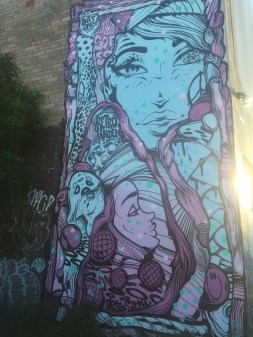
This first semester of my Masters of Research (MRes) is about becoming a researcher and aiding me with the tools to write. Someone described it as learning how to run a marathon!
My research area is focussed on female street artists and how they view themselves within this art practice.
The course is well structured in regards to the topics, the history of your field, collection of data, how to analyse this data and so on.
One of the assessments is a journal that you discuss the weekly topics. In responding to one of my posts, my lecturer Dr Jack (the sauna) Tsonis challenged me so I thought I would respond here.
We were introduced to the eminent theorists Thomas Kuhn and Karl Popper. Kuhn argues that science is a social process and he coined the term ‘paradigm shift’ (Noughton: 2012). Karl Popper – who looks at falsification – argues that you need to prove a theory incorrect until it is proven correct (Thornton: 2015).
In my post, I stated that I did not think I will be using these two theorists in my research.
Jack argued that I may not cite either Popper or Kuhn in my research, however they discuss the fundamentals of knowledge production and reflect on how knowledge is socially constructed. This alone would help me on my research journey.
That is, their concepts will assist me in becoming reflective in my research which in turn will make me more effective and creative as a researcher?
Jack posed the following questions about my research topic and I will do my best to respond:
Jack: What are the guiding assumptions that structure the current paradigm of interpretation of street art as an academic topic?
Alix: Though the street art movement began in the late 1960s, the amount of research that is available is still relatively new. The current patterns in research look at street art predominately around legalities and use of space. However, the idea that street art is used to create meaning and begin conversations is just starting to emerge. This is happening due to the artists and the artworks interactions with the public in the urban landscape.
Jack: What are the characteristics that make it valuable research?
Alix: Street art is used for social commentary. Works are created to address problems or contemporary events. There isn’t much research in this field, so more needs to be created. It is important to the urban landscape for it creates interactions and disruption of thoughts – creating a way for people to think outside the box.
Jack: What are the human values motivating your work, and why are they just as important as any objective knowledge we can gain about the physical laws of nature?
Alix: For me street art needs to addressed, it needs to be interacted with, challenged and create conversations. Street art is universal, everyone interprets and interacts with the artwork differently. Street art, as the name suggests, takes art outside galleries that often feel exclusive, and onto the streets for everyone to access!
This disruption can potentially create a different way of thinking.
References
Thornton, S. (2015) “Karl Popper”, The Stanford Encyclopedia of Philosophy.
Noughton, J. (2012). “Thomas Kuhn: the man who changed the way the world looked at science”, The Guardian.
 Alix Beattie: Street Art Researcher