
What words come to mind when I mention ‘street art’? Vandalism? Free speech? Beautiful? Offensive? Colourful?
Whatever your thoughts are on the subject of street art, as with most things in life, we need to look at it from various angles: what is seen as vandalism by someone, is considered an art form by someone else.
What is clear is that more academic research is required to study this beautiful art form. The meanings behind some of these artworks, how they engage with current topics both in Australia and around the world, creating awareness of what is going on in our contemporary world and creating an alternative voice.
Street art has the ability to engage an audience and begin conversations between the artist, artwork and public – something that is both powerful and fascinating. Whether it is a protest piece or commentary on current issues such as society’s obsession with celebrity culture – something I discuss below – these works have the capability to create conversations that resonate through the streets visually.
Some important questions I have found myself asking: Have you ever thought about who paints the art work? Are they male or female artists? Would it change you attitude to the work if you knew the sex of the artist?
Street art is a male dominated movement. Why? Is it because of the frequently dangerous nature of the movement. Works often need to be undertaken at night and in alleyways. Or is it because of the socially constructed gender role of society that makes this a masculine practice?
Through the article that follows, I discuss how street art creates conversations in the urban landscape, delve into the history of graffiti, introduce the first female graffiti artist, Lady Pink, and discuss how some of the female artists situate themselves within this masculine practice.
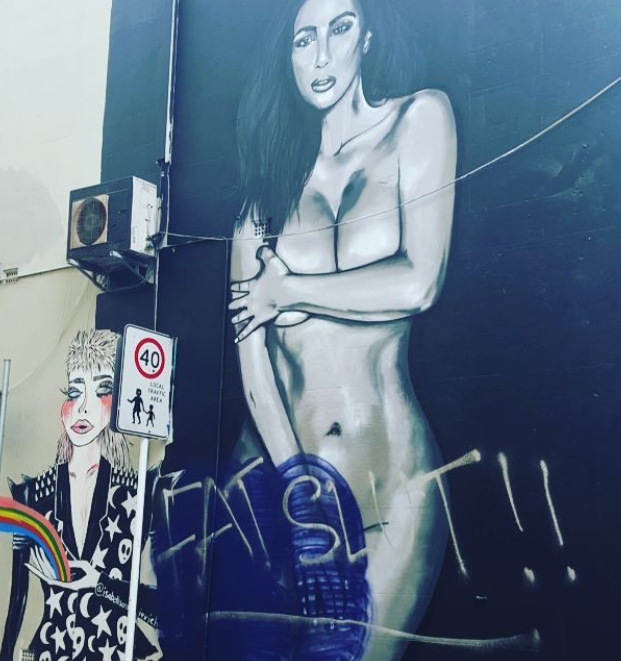
Kim Kardashian is always likely to get you a headline. Her most recent Instagramed nude selfie – or nudie – once again brought the Internet to a standstill as her endless self-promotion lit up discussion boards and gossip columns.
This selfie was of Kim standing naked in front of a bathroom mirror and was posted on 7 March this year.Another self-promotion megastar and Kim’s husband, Kanye West, re-posted this image, declaring her his ‘muse’.
The happy couple must have sat in their living room feeling very self satisfied with their millions of ‘likes’ and the headlines that followed. They once again proved that tits and biceps count for more than talent in a world dominated by social media.
But this is not an essay about the Kardashians or Kanye, but one about the role of public art in modern global cities like Sydney.
This is a story about the rise of graffiti, from how an illegal subculture reflecting gang loyalties in the urban slums of the United States, has turned in a cultural industry in the form of street art. This is a cultural industry that achieves what many mediums fail to do: create conversations about the society we want to live in, discuss political and social events, and allow a cultural battleground to play out in ways that its originators would never have dreamed of.
So what does this have to do with Kim and Kanye?
Apart from making a great headline for this story, their images recently created just such a conversation about Sydney’s cityscape, the role of public art, gender politics and even the word ‘slut’.
It played out like this: Melbourne street artist, Lush Sux, recreated the naked Kim in a controversial mural in Sydney. The mural, which was created within a week of the original of Kim’s photo, appeared in a lane way in Sydney’s Chippendale outside of Zigii’s Art, Wine and Cheese bar. The artwork triggered a torrent of responses from the public: some good, many bad. In the end, someone responded by defacing the work by spraying ‘fat slut’ over the top (see Figure 1).
Yes, ‘slut’! I may not like Kim or the rest of her annoying family, but I dislike that word more. Not to be outdone, local Sydney artist Scott Marsh ‘replied’ to this artwork by creating a mural of Kanye. Marsh’s six-metre mural was of Kanye being passionately kissed by his biggest fan: ‘Kayne’. Scott Marsh painted this in response to a photo-shopped image that had been circulating the Internet of Kayne West and Kim Kardashian, which a Buzzfeed writer, Jen Lewis, had created and she had superimposed Kim’s head for Kayne.
So is a naked reproduced selfie of Kim art? Why would someone deface it with the word ‘slut’? Why did Kanye’s image not get defaced? Who gets to decide what is art anyway? And how did an illegal practice become ‘street art’ that now is celebrated across global cities and has even made its way into some of the world’s elite galleries?
Street art was once simply graffiti and most often appeared in rundown parts of our urban environments or the back of a bus. Today, however, street art is embedded everywhere you look within our urban landscape: from the side of buildings, to trains and telegraph poles, to alleyways and even electrical utility boxes.
To understand these artworks that are present in the urban landscape we firstly need to look at the historical aspect of this sub-culture of street art – graffiti.
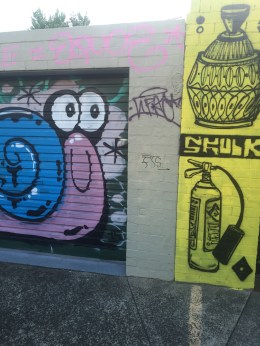
Graffiti emerged in New York during the mid to late1960s with the establishment of ‘tagging’. The word ‘tag’ represents an artist’s street pseudonym.
‘Tagging’ was used to demonstrate the artist’s existence in the urban landscape, ‘mark’ their territories and generate credibility – or street cred – with other graffiti artists (Wacławek: 2011) (see Figure 2).
The next stage of evolution of graffiti occurred in the 1970s with the emergence of ‘throwies’. Throwies are elaborate tags: think of someone’s signature turned into a three-dimensional artwork and you have a throwie. These continued to expand in size and colour.
Throwies started appearing on the side of subway trains. Despite the elaborate nature of these works, they still needed to be simple enough to be produced very quickly so the artist could move away without being detected. It was a balance: the artist wanted to express themselves but had to do so in a high risk environment with police ready to pounce.
During the late 1970s ‘Pieces’ – short for ‘masterpieces’ – were created (see Figure 2). These elaborate murals, also known as ‘burners’, conveyed the artist’s pseudonym with symbols.
Many of the artists worked in gangs, and were in continuous competition with each other. The illegal nature of ‘tagging’, creating ‘throwies’ on the side of subway trains, or ‘pieces’ in abandoned building, meant that this emergent sub-culture was male dominated (Siegel: 1993). Combined with the fact that the artworks had to be produced at night to maximise anonymity and avoid the police meant that the presence of women was almost non-existent.
In other words, despite the political and social statements being produced and the counter culture element of this artistic expression, when it came to men and women, they simply reproduced the socially constructed gender roles dominating society (Buiten: 2016).
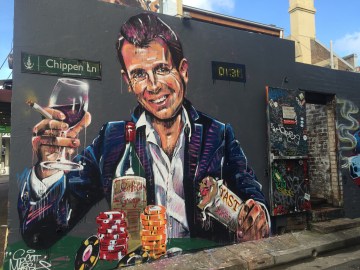
Street art has continued to evolve and is no longer simply tags, throwies or pieces, but produce both works of aesthetic beauty and social commentary. One recent example is Scott Marsh’s recent piece featuring a portrait of the Premier of NSW, Mike Baird, posing with a glass of wine, a bottle of Grange and cigarette in one hand, a kebab in the other. Casino chips and a very expensive bottle of wine, Penfolds Grange, surround him. Next to him is a digital clock that states 1:31am (see Figure 3). A clear commentary on Sydney’s controversial lockout laws as well as the political power of the casino, Marsh makes a statement of corruption: do we remember the $8,000 bottle of wine that brought down Premier O’Farrell?
It is for this reason that social researcher Cameron McAuliff (2012) argues that the impact of graffiti in the current urban environment is a contentious discussion within the contemporary city. Not only are the responses from the public supportive or repulsed by this creative visual sub-culture, so are the discussion that follow.
Whether your opinion on street art is positive or negative, the imagery of street art within our urban landscape is visual in our everyday lives.
The emergence of street art as a subculture has allowed artists to expand their art practices into the public space and to use their works as a tool to create conversations – just ask Mike Baird. Street art, which now encompasses more than just graffiti, includes several forms of art practices: stencils, murals, paste-ups and sculptures.
Visually, the artist uses the urban landscape as a backdrop for their artwork. While the primary purpose may be aesthetic, they also to allow a conversation to take place with the viewing public, other artists as well as artworks within the public sphere they may be responding to.
This means that today, such artwork plays a pivotal role in the creation of dialogues. These artworks have the ability to address issues that we encounter in our everyday lives, respond to political current matters, and as well as act as traditional political pamphlets that aim to educate people with topics that may not be accessible.
As researcher Anna Waclawek suggests: “Street art aids in the creation of city spaces by occupying a physical location in the cityscape and by engaging people in the experience of art” (2011 p.70). But this experience is not limited to the aesthetic: it is also an engagement that creates dialogues and interactions between the artist, the artworks and the viewer around contemporary issues.
So let’s return to Kim and Kanye. Lush Sux’s Kim and Marsh’s Kayne created a number of dialogues that exemplify Waclawek’s point.
To begin with, the artists involved have created a dialogue between each other. The artworks, which were created and situated together, began the dialogue of emphasising the presence of these two celebrities within the media and public eye. First Kim, then Kanye: two pieces of art that portraying self-promotion and the media’s obsession with celebrity culture.
The second dialogue created is between the public and the artists – the aim of most ‘public art’. If Lush Sux was trying to make a point about celebrity culture, the public reacted. Within 24 hours the artwork had been tagged by another artist, and later defaced by an unknown individual with the words ‘Fat Slut’ sprayed across bottom half of the mural.
It may seem the Lush Sux wanted a conversation about celebrity culture, but some members of the public wanted nothing to do with Kim!
The word ‘slut’ has a number of implications. As a feminist myself, I wonder why this word was selected. What message was the person who defaced the work trying to convey; retaliations against the media’s coverage of Kim Kardashian? Or is it more an attack on women who choose to have sexualised public personas? Or was it merely a conversation starter or a reaction to the imagery?
The third dialogue then moved between the local residents and the artwork. Complaints were made to the local council about the imagery of the mural. In response to the resident’s complaints, the City of Sydney issued a warning to the owner of Zigi’s to have the artwork removed within two weeks.
It is importance to us, as residents of this city, to consider these events. It is intriguing as to why the Kanye West mural did not create as much controversy. While much was said of the Kanye’s portrait social media, blogs and the on-line news, it was not defaced nor any complaints made about the imagery. This creates a further dialogue when looking at the artworks together. Even though created by two different artists there is an interaction with the public that is kept undisclosed.
This is a discussion that Alex Walacwek describes as an ‘unmediated response’ between different sections of the public as well as the artists involved (2011 p.90). Again, these are engagements that online creators of content would be envious of.
And this is the power of street art: its ability to create conversations in the public sphere. This can be seen with the defacing of the artwork, why was one defaced and the other one was not?
But controversy in street art is nothing new. While above I talked about the masculine nature of this art form, it is the women that have often led conversations – and conversations that many did not want to have.
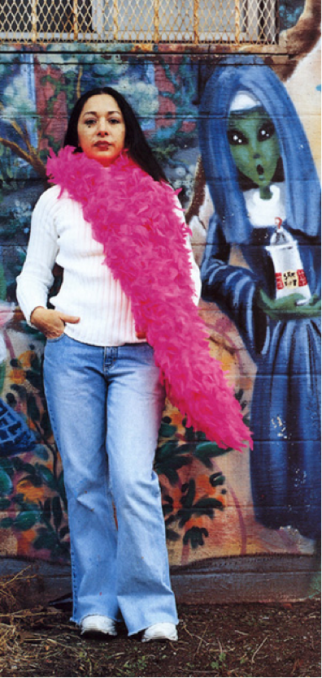
Feminism was a topic of conversation by the first female street graffiti artist, Lady Pink (Siegel: 1993) (see Figure 4). She began painting subway trains at the age of 15 and her mere presence on the street challenged socially constructed gender roles within the arts. Lady Pink insisted on being part of the street art movement noting in an interview:
“I started in 1979 and it was totally a male dominated profession. I was down with two gangs…but the boys refused to take me to the train yards, whining that I’d cry or scream, or that they’d have to protect me” (Siegel:1993 p.67).
She refused to be cast aside, confronting her male contemporaries in many ways. But she also wore masculine clothes to fit in and not be noticed. This was a way to protect herself from being sexually assaulted.
This gender role of masculine aspects can be seen through Lady Pink’s work. She used her work to begin conversations about violence against women and minority groups.
This was controversial and confronting – more so because a ‘mere’ girl used a masculine tool to confront injustices she felt were important to talk about.
Australians female street artists have picked up this fight. Artists such as Baby Gorilla, Vexta and Kaff-eine are using their artworks to raise social, cultural and political while also challenging gender roles within this art movement.
Baby Gorilla whose is about challenging despair and constrictions sees women within the street art movement as “fiesty”. This is because they confront the gender imbalance in the industry simply by being there. Baby Gorilla’s own art practice attempts to create a space for women to prove themselves and fight for opportunities to be equally represented.
Vexta seems to agree with Baby Gorilla. She uses her art as a way of challenging gender imbalance and exclusion. In a recent interview for the ABC, she notes that: “A lot of time you have to work twice as hard and be twice as good to get noticed …”.
Artist Kaff-eine approaches the subject of gender imbalance from an alternative angle. Beginning her career as a lawyer, she started her street art career as an anonymous figure due the illegal nature of the work – you can’t have a lawyer being ‘busted’ for graffiti!
As first, people were unable to identify any traces of gender within her artworks. But neither does she feel that this is important. When I met her at a recent opening, she said to me:
“I’ve never really viewed myself as a female artist — I’m simply an artist. That is how I’ve gone through most of my life…”
Kaff-eine defines the gender imbalance within the sub culture by arguing that it doesn’t matter whether you are male or female, an artist is an artist.

Kaff-eine has found a way to use art to respond to poverty, violence and suffering in the slums of Manila. Kaff-eine is the Creative Director of Cheeseagle, a collaboration of artists who are using their art form as a tool to begin conversations and discussion around social impact. On a trip to the Philippines, Kaff-eine came in contact with a slum on the outskirts of Manila.
While ignored by governments and decision-makers, this slum community plays a vital role for Manila as a functioning city. This is because they sort out and recycle garbage which they then on sell – doing a job that the government would need to have employees to do.
If this community decided to not do what they do, it is likely that the garbage would overtake the city, causing major problems of sanitation and the obvious health risks that follow.
Kaff-eine’s project is ‘Happy Land’, after the local name for dumpsite, hapilan. The artists are using their art to highlight the plight of this community, the role that they play and to raise funds to provide shelters for those inside the slum. The concept behind this project is to create a better understanding of this community and make people aware of their contribution to society in Manila.
The community recycles and reuses materials for its own purposes also: collecting and using the trash that is thrown out to build their houses that they live in. But these are fragile buildings susceptible to leaks, the heat, and, as Kaff-eine told me, are just ‘ugly’.
Cheeseagle, as a collective, thought that they could improve the living standards of this community through the use of tarpaulins and street art.
Kaff-eine paints portraits of local residents on tarpaulins, which can then be used as roofs for the houses.
The murals also alter the local physical environment. Like any public art project, they create a unique aesthetic within the context in which they occur.
She then uses these images to sell and raise money for the communities – and as she does, she raises conversations about those living on waste and the by-products of our society.
Like any street art fun, I long to meet Banksy. His creativity, political messaging and audaciousness are now infamous. But Banksy is only artist whose aim is to prick our consciousness and start a conversation.
While a replication of the Kardashian clan may seem a world away from the politics of poverty and slum dwellers, for the artists involved they are not. They are about shining a mirror on our society and making us ask questions.
And if such conversations are not your thing, you can simply enjoy the aesthetics of what these street artists bring.
It is for these reasons that street art is more than just an aesthetic intervention into our urban landscape: it is also about having conversations in the public sphere.
References
Buiten, Denise (2016) ‘Sex and Gender’, Chapter 7 in Arvanitakis, James, ed. (2016) Sociologic: Analysing Everyday Life and Culture. South Melbourne Victoria: Oxford University Press, 119-139. Print.
McAuliffe, Cameron. (2012) Graffiti or Street Art? Negotiating the Moral Geographies of the Creative City. Journal of Urban Affairs 34.2: 189-206. Web. 14 April 2016.
Siegel, Fern. (1993) Lady Pink: Graffiti with Feminist Intent. Ms 03: 66. ProQuest. Web. 28 April 2016.
Wacławek, Anna. (2011) Graffiti and Street Art. New York: New York: Thames & Hudson, Print.
 Alix Beattie: Street Art Researcher