
The definition of street art is in perpetual debate – for the art form is varied in both media and imagery (MacDowall, 2014; Wacławek, 2011; Young, 2014). In fact, Dickens (2008) argues that street art can best be described as “post graffiti” (p. 472) – that is, an art form that has extended from the graffiti movement .
Another way to understand street art comes from Austin (2010, p.44), who describes it as “…a fresh and unexpected new skirmish line in modern art”.
To define street art I draw on these three specific qualities that best capture the subculture: artwork, location and audience.
Firstly, the artworks defy the confinements of the gallery space. The artworks that are located on the street are encountered by everyone in the urban landscape.
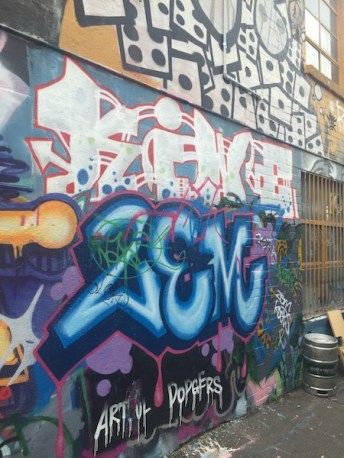
Street art is an art form, regardless if the work is sanctioned or un-sanctioned, that uses site-specific spaces in the urban landscape. Graffiti can be classified as street art for both use the urban landscape as a canvas, though street art varies in different media, not just the use of a spray can.
Secondly, its location – the street – is the focus of the artwork (Danysz, 2010). Artists use the street as a canvas to produce their artworks. By placing the works on the street, the artist create conversations between the artwork and the viewer, creating a surprise element when viewing the work in an everyday environment. This creates a disruption of thought, for the audience is exposed to artwork and alters the viewers thought process.

This street context is key to understanding the difference between graffiti and street art, for the interactions with the audience are different: which brings me to the third dimension – the audience. Jaklyn Babington of the National Gallery of Australia, argues that the audience of each practice signifies the difference between movements (Bentley, 2015). Graffiti writers speak to other graffiti writers, whereas the audience of street art is anyone who encounters the work.
Graffiti and street art are similar for they both create artworks and use the street as a canvas. The audience is the key definer between the subcultures. Graffiti writers are talking to other graffiti writers and street art is talking to anyone who walks through the urban environment.
References
Austin, J. (2010). More to see than a canvas in a white cube: For an art in the streets. City, 14(1-2), 33-47.
Bentley, R. (2015). Cutback. (PhD thesis), Western Sydney University
Danysz, M. (2010). From style writing to art: A street art anthology. Rome, Italy: Drago.
MacDowall, L. (2014). Graffiti down under ground. Artlink, 34(1), 18-21.
Wacławek, A. (2011). Graffiti and street art. London, UK: Thames & Hudson Ltd.
Young, A. (2014). Street art, public city: Law, crime and the urban imagination. London, UK: Taylor & Francis Ltd.
 Alix Beattie: Street Art Researcher