
The best part of travelling to my uni – Western Sydney University – is the train journey from Central Station to Parramatta. Viewing ‘pieces’ created by graffiti writers on the walls that encase the railway tracks. The combination of text, characters and symbols that allow the names to jump out of the wall. A blur of colour – depending on the speed of the train – or a slow train that allows for the gallery of work to be exhibited with every detail viewed.
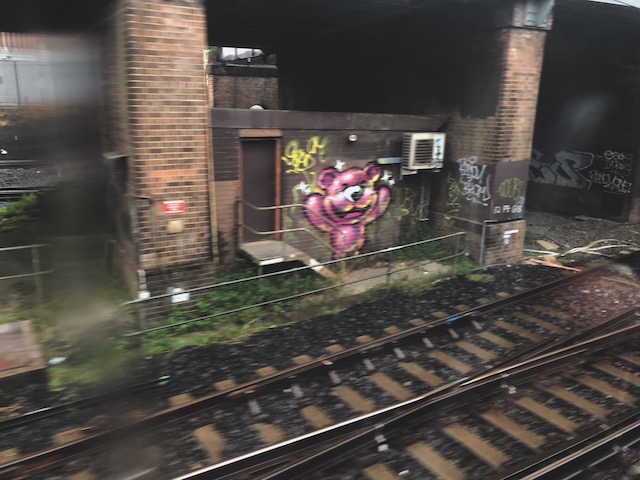
Recently, I saw an image on the train that caught my eye: a mural of a bear (which reminded me of Lotso from Toy Story 3). My initial thought was, ‘I want this image for my instagram’ but I was too slow and missed the shot. I spent the day hoping it would be there the next day – always a risk when you research an ephemeral art form, how long it lasts depends on too many factors.
Whilst waiting on the station the next day, I watched the train roll in and was silently outraged to see the carriages were covered in advertising – including the windows – making it difficult for me to look out and see passing artworks.
This made me reflect on the way advertising saturates the urban environment.

During artist interviews last year for my Master of Research thesis, Women on walls: Engaging street art from a female artist perspective, discussions of advertising came up in conversation with the artist. She stated that ‘advertising was a form of vandalism’, for we are subjected to this everyday of our lives. Brisbane based artist Buttons noted that :
“I would rather see a piece that someone has actually put effort in, picked the good colours and have actually done something creative, I would rather see that all over trains, than seeing fucking ads for commonwealth bank”
Graffiti constantly has negative connotations – something heavily influenced by the media. A recent Sydney Morning Herald article, Fury as more graffiti hits anti-violence sign put up after mum’s death, described how a ‘white ribbon’ billboard advertisement is repeatedly being vandalised. A person, or a group of people, blacken the letters of the sign to alter the meaning.
While this is an illegal and highly offensive activity, this is not graffiti – it is a form of vandalism. This is both incorrect and creates the above-mentioned negative connotations around the subculture.
An article by Liam Miller, Not all graffiti is vandalism – let’s rethink the public space debate, draws out this distinction between vandalism and graffiti. Miller discusses how advertising can be classified as vandalism or a type of graffiti. As Liam states:
“If vandalism is abhorrent because it attempts to own public space, then advertising is vandalism.”
Graffiti writers tag their names as a sign of marking territory and claiming of public space. This public space is for all to enjoy, which also allows people to have an opinion on what they see. Graffiti can be described in multiple ways including a “…range of physical marks… placed on surfaces through the built environment” (Crisp, Clarke, & Frederick, 2014, p.84), as a mark making practice (Baird & Taylor, 2016; Crisp et al., 2014), a medium for self-expression (Truman, 2010), and vandalism (Little & Sheble,1987). However, graffiti writing is about imagery, it is either the artists name or pseudonym that is inscribed through characters and symbols that are located in the urban landscape.
If you look at advertising, could you apply the above mentioned descriptions for advertising? Yes, but does the media describe advertising as vandalism? Rarely!
I recently read an article by Christensen & Thor (2017) who argued that graffiti and street art, whilst they offer dialogues that create conversations within the community, this media has now been commodified. This has been the result of the gentrification of neighbourhoods creating housing price inflation that has forced out long established communities. This gentrification of suburbs is debated by Blanché (2015), who discusses the positives of neighbourhood revitalisation through the artworks on the street. In contrast to Brighenti (2016), who views the gentrification through a Marxist analysis of street art, discussing the impacts that the valorisation of the art form can impacts property prices and potentially shift citizens from their communities.
This gentrification is different in comparison to how street art and graffiti writers view the communities where they complete their work. Through their research (Christensen et al, 2013) found that, the “notion of street art and graffiti as ‘pollution’ and ‘vandalism’ was countered by participants who noted that advertising on the sides of buses, billboards and the like are just as much ‘visual pollution’ as anything created by graffiti or street artists” (p.607).
This pollution that is described in the way in I found the advertising that was wrapped around the train was offensive and I would consider this as an act of vandalism.
Street art and graffiti can be illegal (and legal) but the artists can re-shape the urban landscape. In contrast, while most advertising is legal, it often detracts from the public landscapes that we are all supposed to enjoy – and for me, that is what should be considered vandalism.
References
Baird, J. A., & Taylor, C. (2016). Ancient Graffiti. In J. I. Ross (Ed.), Routledge handbook of graffiti and street art (pp. 17 -26). Florence, Kentucky USA: Taylor and Francis.
Blanché, U. (2015). Street art and related terms – discussion and working definition. Street art & urban creativity scientific journal, 29, 32-38.
Brighenti, A. M. (2016). Graffiti, street art and the divergent synthesis of place valorisation in contemporary urbanism. In J. I. Ross (Ed.), Routledge handbook of graffiti and street art (pp. 247 – 259). Florence, UK: Taylor and Francis.
Christensen, M., & Thor, T. (2017). The Reciprocal City: Performing Solidarity-Mediating Space through Street Art and Graffiti. International Communication Gazette, 79(6-7), 584-612.
Crisp, A., Clarke, A., & Frederick, U. K. (2014). Battlefield or gallery? A comparative analysis of contemporary mark-making practices in Sydney, Australia. Australian Archaeology, 78(1), 84-92.
Little, R. E., & Sheble, M. A. (1987). Graffiti vandalism: Frequency and context differences between the sexes. American Journal of Criminal Justice, 11(2), 217-226. doi:10.1007/BF02885658
Truman, E. (2010). The (in)visible artist: Stencil graffiti, activist art, and the value of visual public space. Shift(3), 1-15.
 Alix Beattie: Street Art Researcher