
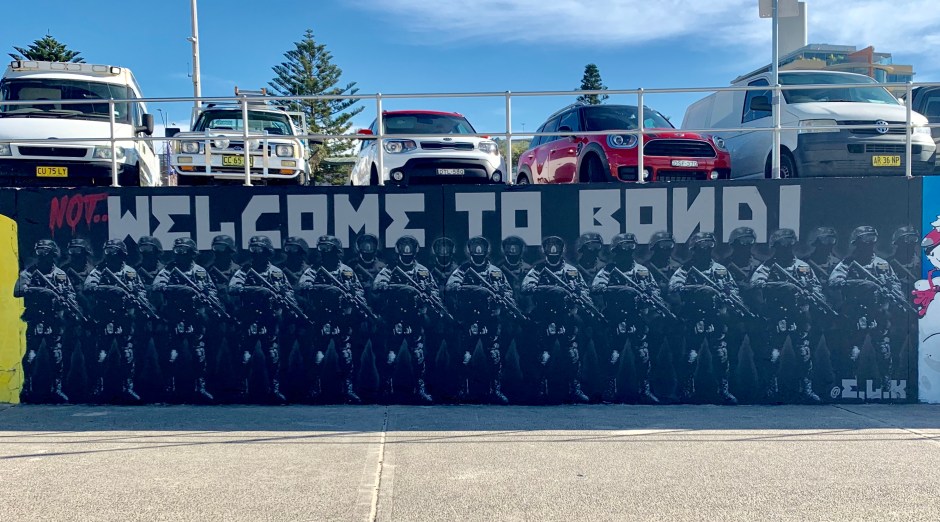
Mainstream media outlets in Australia recently focussed on a controversial work by stencil artist, Luke Cornish (ELK). Luke created a mural on the Bondi Beach seawall that generated conversations about the treatment of refugees in Australia, the right to free speech and the impact of artworks that adorn the urban landscape. The imagery of the mural caught the attention of the media, Australia-wide, and the conversation reverberated through social media.
Before continuing, it is important to note that Luke has always confronted controversial topics: from the war in Syria to the impact of the Afghanistan conflict on veterans.
Luke’s mural depicts 24 Australian Border force officers standing in a line with the words “Not welcome to Bondi”. The mural was designed by the artist to create awareness around refugees and asylum seekers. The number of officers stencilled represent the 24 suicides that have occurred in Australian detention facilities – both off and on-shore – since 2010.
Since the late 1970s, the Bondi Sea Wall has been open to artists to submit artworks and, as stated on the Waverley council’s website, the wall “…has featured a mix of street and contemporary art with strong social and political messages throughout the decades.”
While most of the works go relatively unnoticed, this time the work created controversy with the public expressing varied and mixed opinions on the piece. These opinions were battled over both social and traditional media, with one Waverley councillor requesting the removal of the mural due to the imagery causing offence.
Like the most impressive art everywhere (both in galleries and on the street), this piece created a place for people to have conversations about issues that we sometimes prefer to ignore. Here, the artist created a voice for those who are unable to be heard with the purpose of seizing the attention of the Australian public about the conditions in which they are living in as well as loved ones that have been lost.
But unlike art in galleries, street art takes these conversations to the broader public.
It is this argument that street art has the ability to be able to create conversations by being in full view of the urban landscape. As Luke stated:
“It’s art. It can’t all be butterfly wings and bubblegum paintings. It needs to make people think. That is the whole ethos of street art. It is political by nature and it is ephemeral by nature too. So I’m not going to be upset if I go down there and it has been painted over. It has served its purpose.”
Petitions were created and shared throughout social media to both save and remove the artwork. Waverley Council met to discuss the future of the artwork with a formal vote being called that resulted in a 5 to 4 outcome to keep the mural.
After these chains of events, the mural was then anonymously vandalised the next day.

Street art engages people on multiple levels. To begin with, through the imagery that engages the audience to reflect, ruminate and think about the complexities of the issues raised. As a result, street artists are creating conversations in their interactions with the audience. More so, these images and conversations are being projected throughout the world through the internet.
This had me reflecting on my research – whilst living in the Laramie, Wyoming (USA). I have been scouring news sites and social media for information about the work as well as reading messages of support and hate to Luke. My research aims to understand the way audiences interact with works and how this online information for street art can be accessible to help people understand the impact that art can have, as well as to understand the complexities of imagery. This should go beyond random social media comments.
When information is lacking, mainstream media can take control and provide their own subjective interpretations and opinions.
Reflecting on Greengard’s book, The Internet of Things, and how this technology created a connected world, through “… digital technology (that) intersects with our lives every day, and increasingly cloud computing, mobile apps, crowdsourcing, social media, and big data play a crucial role in influencing behaviour and defining human interaction” (2015 p.26).
The internet plays an increasingly important role in everyday lives. We are seeing the continued crossing over of the virtual world into the physical world, which impacts how artists use and interact with the internet.
Luke responded to the vandalism of his work by using Augmented Reality to make the mural available in the digital world: the mural maybe defaced in the physical world, but can be accessed virtually. The audience can view the original work in an alternative space.
The questions I am pondering include whether additional information will shape some of these online conversations? Do audiences want to understand more about the artwork? Or is it just a passing phase around the hype of this one specific work?
Just some things to think about!
__________________________________
*Thanks to Luke Cornish for supplying the main image for this piece and for your constant support
**This blog was written during the occurring events, however I joined up with Prof James Arvanitakis and turned it into an article – Power, politics and art
References
Greengard, S. (2015). The internet of things. Cambridge, Massachusetts: MIT Press.
 Alix Beattie: Street Art Researcher