
Cooperation, partnership, alliance, and synergy are all words that describe ‘collaboration.’
The etymology of ‘collaboration’ is a combination of Latin and French phrases that come to represent the “act of working together, united labour”
Collaboration is a word that I have used from the beginning of my research: wanting to work with the artist to create a space for information to be available for audience when viewing their artworks in the everyday.
My research applies a Heidegger concept of ‘crossing the threshold’ (1927/1962). This threshold moment is created by a disruption of thought. I argue that this disruption of thought occurs when you view artworks unexpectedly. One minute you a walking down the street thinking of one thing and next you see a mural that has turned the urban landscape into a canvas. The viewer may be captured and wonder about the meaning behind the work? The ‘affect’; Do I like what I see?
My project, Refracted Cubes, is about curating a space for audiences to find out more about artworks that penetrate the everyday – with a specific focus on street art murals. This research allows viewers to delve past the imagery and into the space of understanding the artist’s concept behind the work.
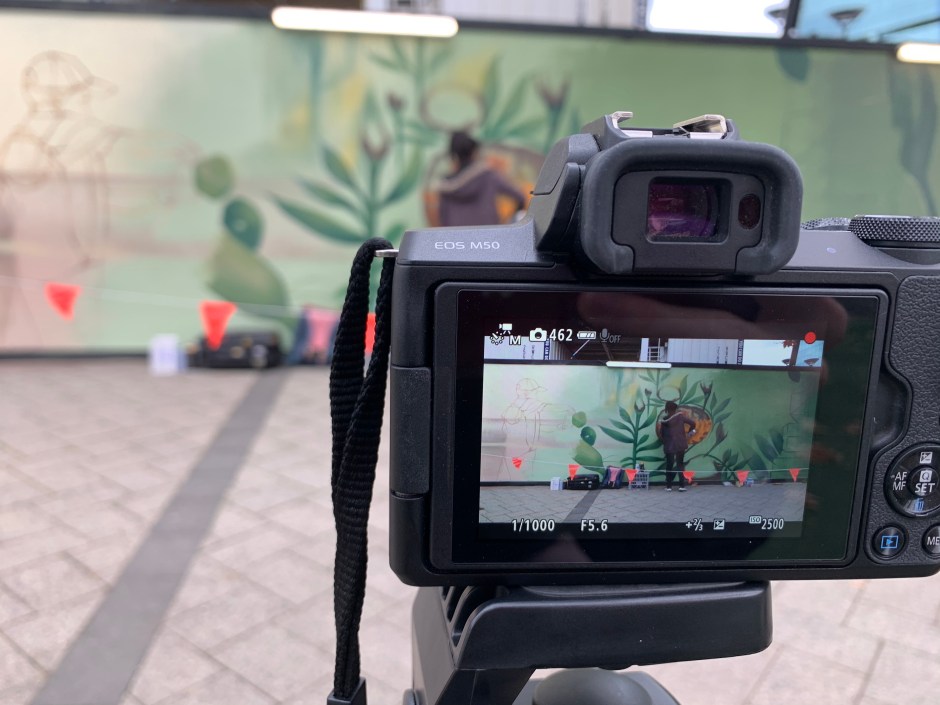
I documented and curated Refracted Cubes with three artists as they created their murals. The documentation aspect was a journey of discovery for me. I learnt that artists who work in the urban environment can find conditions difficult to negotiate: the weather, the facilities, and the interactions with audiences – sometimes friendly but potentially volatile – all need to come into play when creating murals.
I want to discuss three insights that emerged.
Timing
Timing is key. You can be onsite for hours and sometimes the timing just doesn’t work out but at other times you experience magical moments. When it comes to filming for example, I needed to work out the best time to deal with the sun and I had negotiate the weather. The sound scape can impact filming (2 of the artists were creating murals around a building site).
There is also the timing of the artists: I would sometimes turn up and they would be going to grab a coffee or lunch, or they just needed a break. Other times they felt like just sitting – my timing and their timings did not always coincide.
Learning to negotiate time is important for a researcher.
Interactions
If an artist works in a studio, they control any interactions with the public: who comes into their studio, who sees their work, who they chose to engage with. Artists who use the urban environment as a canvas do not have such luxuries. While each of the artists enjoyed engaging with the public, the terms of where difficult to negotiate. People wanted to discuss the mural, and where often complimentary, but the artists did find it occasionally. They did report to me that they had experience hostility – which had severely impacted their work. While all the interactions I witnessed were positive, I sometimes became an interlocker so the artist could continue their work while I negotiated the conversation.
Facilities
Again, if an artist works in a studio, facilities are available. Be it toilets, fresh water, access to equipment, Street artists just don’t have that luxury. If the artists need to get something from their car or are up on a ladder or scaffolding, they need someone to monitor their belongings. While working, I became almost like an assistant, helping in many ways – sometimes moving equipment, grabbing coffees and lunch, keeping belongings safe. Again, it is not something I expected as part of my research journey.
Working with artists for this research has been one of engagement, negotiating, waiting for that perfect moment and the to be able to be a part of the entire process. A learning curve for me as a researcher. I am not an artist but was able to understand the challenges confronted by street artists.
Reference
Heidegger, M. (1927/1962). Being and time, [trans. J. Macquarrie & E. Robinson]. New York: Harper & Row.
 Alix Beattie: Street Art Researcher