I am a Street Art Appreciator who is undertaking my Masters of Research at Western Sydney University. I work for an art gallery based in Sydney when I am not researching. My aim in life, to help people engage and acknowledge the amazing amount of street art that we are surrounded by.
I recently watched Girl Power, a documentary on female graffiti writers (remembering that graffiti is a sub-set of street art which I have written about here).
The film was made by Sany, a Czech graffiti writer, who wanted to create the first female graffiti writer film. The film documents Sany’s double life as a female graffiti writer: negotiating work, life, friends and family and how she balances (and sometimes doesn’t balance) this double life.
The rawness of the film narrative, including the technique and vision captured by the cameras, captures how women negotiate this subculture, through the view point of the female graffiti writers. The audience is taken on a journey through the eyes of Sany and other female graffiti writers . Some parts are terrifying, as the women are running from authorities (including police, security guards and transport staff), being caught, questioned and held for hours.
The definition of street art is in perpetual debate – for the art form is varied in both media and imagery (MacDowall, 2014; Wacławek, 2011; Young, 2014). In fact, Dickens (2008) argues that street art can best be described as “post graffiti” (p. 472) – that is, an art form that has extended from the graffiti movement .
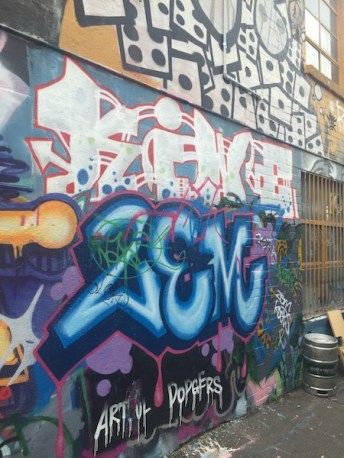
Graffiti| Melbourne, 2017| Photograph Author
Another way to understand street art comes from Austin (2010, p.44), who describes it as “…a fresh and unexpected new skirmish line in modern art”.
To define street art I draw on these three specific qualities that best capture the subculture: artwork, location and audience.
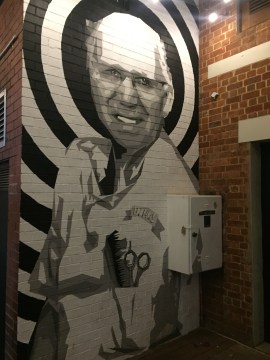
ELK – Father Dave – Martin Place – June 2016 – Photograph by author
During the month of June 2016, ANZ sponsored a street art project called Inspiring Locals – which highlighted locals who are making a difference within their communities. This project was coordinated by Melbourne art consultant, Alex McCulloch.
Four street artists where selected for the project, Luke Cornish (ELK), Kaff-eine, Adnate & Stormie Mills. Each artist selected a person who they thought aligned with ANZ’s vision statement of diversity, inclusion and respect as everyday priorities, both inside the workplace and out.
The four artists where assigned walls around Sydney;
ELK – Father Dave in Martin Place and conductor Dr Nicholas Milton at Chatswood;
Kaff-eine – LGBTI activist Katherine Hudson at Bondi Junction;
Adnate – Aboriginal activist Jenny Munro at Haymarket; &,
Stormie Mills – retired Parramatta Eels player and community activist Nathan Hindmarsh at Parramatta.
The project is important for many reasons but here I want to discuss just three: the creation of community, knowledge production and, pure enjoyment. Continue reading “#Inspiringlocals”→
What words come to mind when I mention ‘street art’? Vandalism? Free speech? Beautiful? Offensive? Colourful?
Whatever your thoughts are on the subject of street art, as with most things in life, we need to look at it from various angles: what is seen as vandalism by someone, is considered an art form by someone else.
What is clear is that more academic research is required to study this beautiful art form. The meanings behind some of these artworks, how they engage with current topics both in Australia and around the world, creating awareness of what is going on in our contemporary world and creating an alternative voice.
Street art has the ability to engage an audience and begin conversations between the artist, artwork and public – something that is both powerful and fascinating. Whether it is a protest piece or commentary on current issues such as society’s obsession with celebrity culture – something I discuss below – these works have the capability to create conversations that resonate through the streets visually.
Some important questions I have found myself asking: Have you ever thought about who paints the art work? Are they male or female artists? Would it change you attitude to the work if you knew the sex of the artist?
Street art is a male dominated movement. Why? Is it because of the frequently dangerous nature of the movement. Works often need to be undertaken at night and in alleyways. Or is it because of the socially constructed gender role of society that makes this a masculine practice?
Through the article that follows, I discuss how street art creates conversations in the urban landscape, delve into the history of graffiti, introduce the first female graffiti artist, Lady Pink, and discuss how some of the female artists situate themselves within this masculine practice.
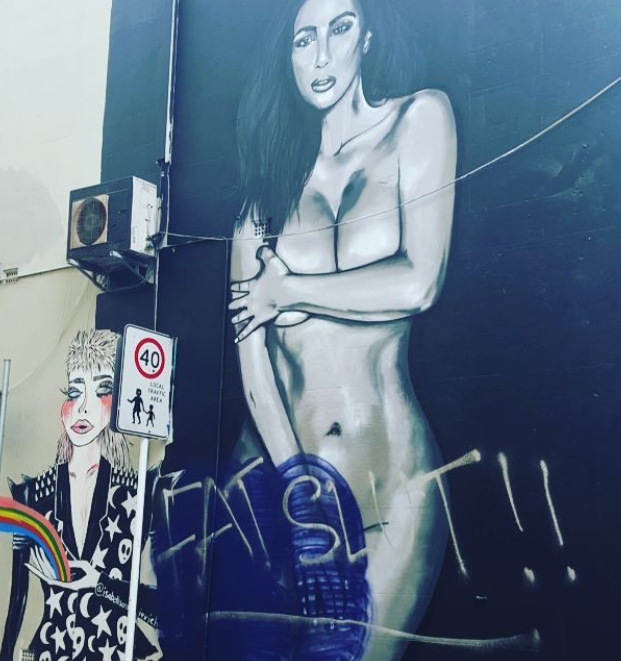
Figure 1: Kim ‘the fat slut’ – photo by author
Kim Kardashian is always likely to get you a headline. Her most recent Instagramed nude selfie – or nudie – once again brought the Internet to a standstill as her endless self-promotion lit up discussion boards and gossip columns. Continue reading “Street-Art-A-Feminist-Playground”→
Thanks to a work colleague, I was fortunate enough to preview the 20th Biennale of Sydney before it opened to the public. The Biennale is an international contemporary arts festival held in Sydney every two years. The title of this years Biennale is “The future is already here — it’s just not evenly distributed” – and it contends with the idea that we live in both a virtual and physical space and sometimes we are caught between the two.
Constantly surrounded by our phones and other devices, we are always connected to social media and the internet 24/7 in this ongoing loop of virtual/physical.
The Biennale, which is held in many different venues around Sydney – with each venue designated as an ’embassy’ (or theme). I have picked three of my favourite works form Art Gallery of NSW (AGNSW), Cockatoo Island and the Museum of Contemporary (MCA).
Knowledge translation is vital to any research project!
When asked ‘what do you research’, the easiest thing is to respond with lots and lots of jargon to sound smart!
It is much harder to communicate your research to a person who is outside of your area without using jargon from within your field.
To be able to explain the topic in an accessible way is beneficial for two reasons. Firstly, it creates ‘new knowledge’ because it expands the research area to people outside the discipline area. Secondly, this creates the potential fore new conversations and therefore, new ideas.
This is the concept of ‘knowledge translation’. It allows for the understanding of your area as well as the exposure of what you are researching. Continue reading “Knowledge-Translation”→
This first semester of my Masters of Research (MRes) is about becoming a researcher and aiding me with the tools to write. Someone described it as learning how to run a marathon!
My research area is focussed on female street artists and how they view themselves within this art practice.
The course is well structured in regards to the topics, the history of your field, collection of data, how to analyse this data and so on.
One of the assessments is a journal that you discuss the weekly topics. In responding to one of my posts, my lecturer Dr Jack (the sauna) Tsonis challenged me so I thought I would respond here. Continue reading “Kuhn-&-Popper”→
Recently I undertook a literature review for my Masters of Research.
This allowed me to delve into my research field and look at the literature surrounding my topic. I found there was limited research particularly when looking at female street artists. There was information on individual artists, however, a discussion on the gender imbalance within the sub-culture seemed to be missing.
Common research surrounding street can be grouped into four key areas: the historical context and beginnings of the sub-culture (Gomez: 1993); more recent research around the legalities (Young: 2013); art in a public space (McAuliffe: 2012); and, the engagement of street art within the community and how it is used as a tool for discussion (Hansen & Danny: 2015). Continue reading “Street-Art-literature-Review”→
Rosenwasser & Stephen’s (2014) concept of ‘freewriting’ encourages the writer within.
The concept of ‘freewriting’ is a method that allows your hands to write what you are thinking continuously for a certain amount of time without editing the work. This allows the mind and hand to work in parallel. All thoughts and ideas are written down without stopping and once the time is over the writer can reflect on the piece and engage with the ideas and thoughts.
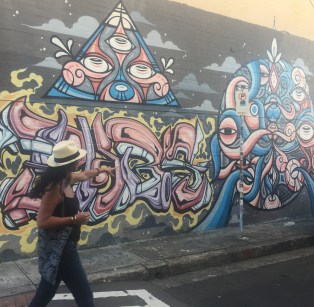
Melinda Vassallo discussing street art- artist unknown-Newtown 2016-Photo by author
Cheryl Giesler (1993: 23) discusses the meaning of linguistic socialisation and the importance of this concept when it comes to research.
What a great term: linguistic socialisation!
Essentially this translates to being able to speak and understand the language of your discipline. That is, to become ‘socialised’ with the specific linguistic conventions of your field and to be able to understand the language used in articles, seminars, lectures and other academic publications.
To be able to place the language of your academic field and put it in the correct context is vital to your research. This is essential as all areas of research have their own meanings of text and it has the capability of changing across disciplines. Continue reading “Linguistic-Socialisation”→




 Alix Beattie: Street Art Researcher